
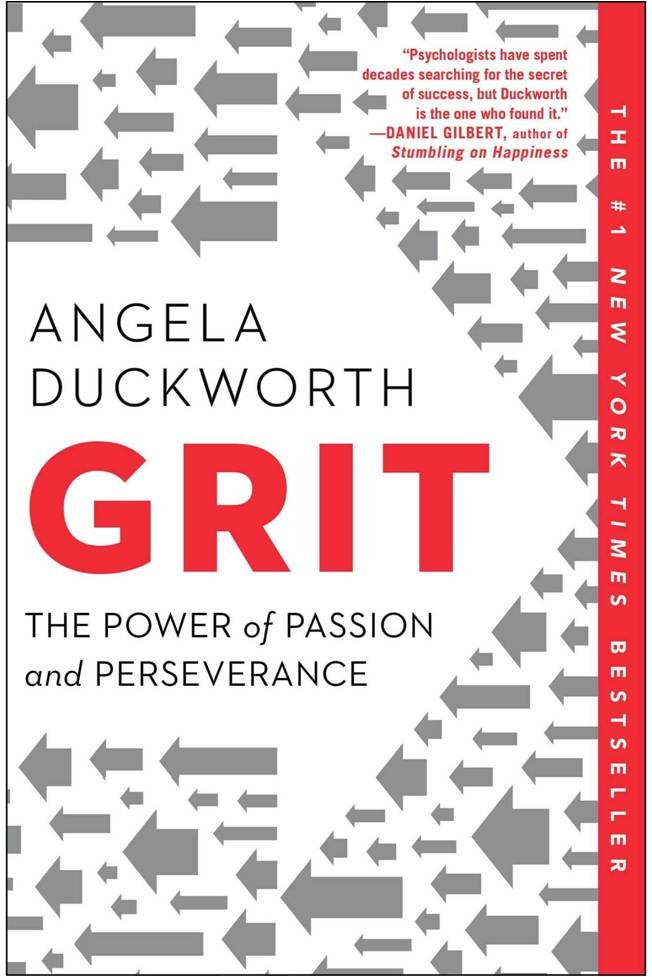
In Grit: The Power of Passion and Perseverance, Angela Duckworth argues that extraordinary achievement comes from the union of passion—a powerful approach to something you passionately care about—and perseverance—resilience and determination to work hard.Duckworth refers to this fusion of zeal and tenacity as “grit.”
According to Duckworth, Grit is crucial because it takes focused effort to develop talent and transfer that skill into accomplishment. Skill results from talent plus effort. Achievement is the result of skill and effort. In the equation, the effort is mentioned twice. The required abilities won’t be acquired if one spreads their effort thinly over too many different areas (lack of focus due to lack of enthusiasm), and those talents won’t convert into success.
Even though it seems apparent when expressed this way, Duckworth’s statements are more in-depth. She thinks tenacity is more significant than “talent” or intelligence in many areas. She also makes the case that the way we raise, teach, coach, and manage individuals may help them develop more Grit.
The three articles from 2016 (in Slate, The New Yorker, and npr) critiquing Grit and the associated research make many of the concerns I would raise. But first, before I get to those papers and my ideas, let me add that Duckworth seems to be one of the academics that take criticism the most willingly. She quickly accepts sound reasoning but also seems torn between the desire to write or speak persuasively enough to sell a book or give a TED presentation, despite being aware of the study’s limits.
The criticisms made by Slate and NPR. The best indicator of success is not Grit. The distinction between “grit” and the prominent five features of conscientiousness is negligible to the degree there is one (making Grit essentially an old idea rebranded with a funkier name). A recent meta-analysis by Marcus Credé, Peter Harms, and Michael Tynan provides evidence for this claim (and forms the basis of the npr piece).The example Duckworth uses in the book’s introduction of grittier cadets having a higher chance of completing the seven-week West Point Beast Barracks training program is also criticized in the npr piece. Grit proved to be an incredibly accurate indicator of who survived and who did not, as she puts it.
Finding what you are passionate about requires searching, as Duckworth discusses later in the book (and frequently). It is normal to take detours. When establishing high-level objectives, don’t be scared to throw out any solutions that don’t work. Putting off what you start might result in missed chances. Find something to be consistent with initially, then be consistent throughout time. Abandon your mid-level objectives if they don’t match your top-level aim. So on. Before settling on the path that consumes them, many of the “grit paragons” Duckworth interviewed for her book investigated variousways.
So, are the West Point graduates quitting due to a lack of Grit or are they moving on to the next stage of their search? Will they have more Grit if we discover them later in life (at a point of success) since they will have found something they are passionate about and want to stick with? How much of the ideals’ impressive grit score is attributable to their success in finding them? How much of the current climate contributes to the prevalence of Grit?
Whether there are restrictions on what we can do as a result of skill is a topic covered in one of the book’s more fascinating parts. The main argument made by Duckworth is that our limitations are unimportant since we are so far from them.
On the one hand, that is true – people might do better by working hard in practically every area (and deliberate practice). A person’s limitations regarding the ability level needed to accomplish their goals should also be considered.
Cal Newport that it is terrible advice to “follow your passion.” You probably won’t succeed if you don’t have anything worthwhile to contribute to your passion. As a result, Duckworth disagrees with the conventional wisdom that pursuing your passion would lead to poverty and believes that individuals should pursue their passions.
Mixed evidence supports Duckworth’s claim. She points out that following a personal interest increases job satisfaction, but this does not always imply that those looking for a career that reflects their passion would be happier. Duckworth also points out that these individuals do better, but what is the overall result of all those who began with this objective? Where have the losers gone?
There is a chapter about parenting. Duckworth acknowledges that the available research is scant and lacking and that no randomized controlled studies exist. Then, since she’s already a mother, she argues that she doesn’t have time to wait for the data.
The next chapter discusses the connection between extracurricular activities and successful work outcomes, mainly when participants engage in the same exercise for two or more years (i.e., consistent parents). She mentions studies on supporting versus demanding parents obtained through methods like student questionnaires. These show that kids who have stricter parents get better marks. Similar studies on top performers reveal that their parents are examples of solid work ethics.
However, Duckworth does not address the common issue with research in this field: they all disregard biology. Do the children’s grades increase because their parents are stricter or because they are the biological offspring of two severe people? Do they have a strong work ethic because their parents instill it in them, or are they, world-class performers? Do their parents constantly encourage them to participate in extracurricular activities, or do they do so because they are the kind of people inclined to be consistent?
These inquiries seem speculative, but the extensive body of twin, adoption and current genetic investigations indicates the solutions. To a considerable extent, a child’s resemblance to their parents is hereditary. Joint parenting, or shared environments, is less influential (and in many studies, zero). Not to argue that interventions can’t be created. However, they do not appear in the variations in parenting that were the focus of these investigations.
Like many other personality qualities, Grit has a moderate heritability rate: 37% for persistence and 20% for passion (the study referenced is here). Since Grit may change over time, Duckworth views this as evidence of the environment’s influence. When arguing that someone’s Grit can be changed, Duckworth briefly discusses heredity.
However, there is little proof that intentional environmental modifications may alter a characteristic when the heritability is less than one. The same study that demonstrated modest heritability also found that shared environments had no impact (e.g., parenting). Influence is difficult to prove.
As a final point, Duckworth discusses the Flynn effect, which she uses to demonstrate the malleability of intelligence and how similar outcomes may be achieved with Grit. Still, she omits the extensive history of unsuccessful IQ-boosting treatments (although recent meta-analyses show some effect of education). Although I agree with Duckworth’s goals, I think there isn’t much literature to back them up.
author bio: Alison Price
Alison Price is an Ohio-based researcher having multiple technical degrees. Her enthusiasm for new and latest technologies makes her different from her peers. She is a master of writing on a vast range of topics with extremely well-researched and well-structured data. Her presentation skills and convincing power helps her win the trust of her clients. Apart from the technical side, she loves to travel and get exposure to amazing cultures and traditions.