
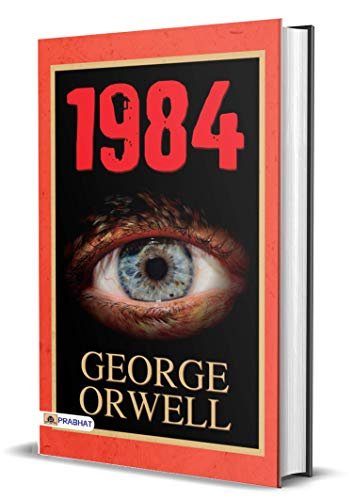
Much of the first half of the year has gone by with a lockdown lull, with a deadly virus on its voyage for a year. With news of infections and death tolls, a dry inhuman statistical tally on the screen but it also substitutes for worry and loss of every loved one, a known one, a relative or a dear friend. The respites have been few and far between, so instead I chose introspection (or perhaps horror) one day and picked up the celebrated copy of George Orwell’s “1984”. Published in 1949, Orwell imagined a dystopian dehumanizing society of Oceania, where clocks strikes thirteen and citizen remains under constant government surveillance, with posters all around with a phrase that has been etched in the mind of people, fiction and reality alike “ Big Brother Is Watching You”, a police helicopter spying every move.
Eric Arthur Blair, popularly known by his pen name George Orwell was born on 25 June 1903 in Bihar, British India. As a son of a British civil servant, Orwell spent his early days in India, where his father was stationed. His mother brought him and his older sister, Marjorie, to England about a year after his birth and settled in Henley-on-Thames. Like all aspirational parents, Orwell was sent to an English prep school at the age of eight later on winning a scholarship to Eton. But the rather mean spirited environment of the said prep school made him disenchanted towards the values of the English public school system. This played a role in him never pursuing University education. His walk to the literary scene of working at Hamstard book shop, reviewing other people’s work took place after his stint as a policeman in Burma and eventually he authored many books and essays of equal merit that hold greater significance in today’s world, perhaps more than how much it did when he wrote them.
The book “1984” revolves around the country of Oceania, where our protagonist, Winston Smith belongs to. It is one of the three super-states of the world of 1984, and is in constant war with the other two, Eurasia and Eastasia. Evened out by similar ideological and resourceful governments, a clear victor never emerges. That also means that the state of Oceania, ruled by a handful, simply known as “Party” with despotic Oligarchic motives, always has a definite enemy that could shoulder the failure of its shortcomings, keep the economies productive that doesn’t let the citizen have its share and a mayhem of continuous poverty, exploitation and fear.
The posters that flap on the streets of Oceania, also have “INGSOC” inked on them, which translates into “ English Socialism”. That stands on its sacred principles of “ Newspeak”, a purposeful ambiguous language that diminishes the range of thought, “doublethink”, a simultaneous belief in contradictory statements. very early on we see our protagonist answering a lingering questions on his mind with a poster on the “Ministry of Truth” that says, “ WAR IS PEACE, FREEDOM IS SLAVERY, IGNORANCE IS STRENGTH” and the “mutability of past”, where the past was dead and future was unimaginable like “a picture of boot stamping on a human face-forever”. The gigantic pyramids adorn the country with the name of workplace and consolidate the functionary of the party with sinister irony of it all, “Ministry of Truth”,that controls the media and education. “ Ministry Of Peace”, which conducts war. “Ministry Of Love”, maintains law and order and “Ministry Of Plenty”, which looks after economic affairs. The party’s means to stay in power remains in denying the people their individuality, forbidding them to have a life of their own, thought of their own, a version of reality that doesn’t come from consciousness but with a fabricated “truth” that the Party approves of, where a simple act of pursuing a solitary respite is a crime.
The pleasure of flesh is looked down upon and hence every time our Protagonist seeks it, he calls it a blow against the party, a “Political act”. Hannah Arendt, who through her works brought “totalitarianism” as a form of government in popular discourse, contends that “the erasure of difference between private and public life” is an act of all-powerful totalitarianism, it manipulates language, and resorts to symbolism. That’s how establishing a sense of self-hood in a totalitarian country which our protagonist resort to in the book is morphed into an act of rebellion, where keeping a diary is a political act, reading a book is a political act, seeking pleasure that is innate to human nature is a political act.
Orwell having survived World War II, having witnessed rampant power exercise from Germany under Hitler’s regime and Soviet Union under Stalin’s occupation pens “1984” not as a verbatim prediction of the world to come but as a warning of what must be avoided. The gloomy ending of the book remains testament of what will become of it if not acted upon. So, being a citizen of the world where the language is still free, the clock is yet to strike thirteen ( barring few who prefers a 24 hours clock) and not under a constant threat of “ Big Brother Is Watching You” ( although subtle state surveillance of “democratic” internet remains put but that’s a discussion of different day) I put the book away, being convinced of dodging a bullet of totalitarianism, which now is popularly conceived as an arrangement of state where handful of elite controls the larger passive mass of people, stripping them of their individual socio- political rights. It is a subversion of personal right and a monopoly over truth by a total state that claims its superiority, morally and otherwise rendering the common mass to a system of political entity that is used to sustain the totalitarian regime. But perhaps, a totalitarian regime reigns its ugly head only when the masses are convinced of dodging it and complacent in its approach.
Following the line of “fact and fiction”, “rule over passive mass” and “propaganda tool” it only seems right to invoke the fictional state of Oceania again, which share the reminiscent and innuendo of such regimes, where the Party vilified a former party leader, Emmanuel Goldstein as the common enemy of the people. Subjecting him to broadcast of “Two minutes hate” in an echo of propaganda. It was him that the fictional book of “THE THEORY AND PRACTICE OF OLIGARCHICAL COLLECTIVISM” is attributed to, that our protagonist lends upon, giving us insights on how a totalitarian state functions where “oligarchical collectivism” not only refers to Party’s INGSOC ( English Socialism) but ideologies of the other two states, such as Neo-Bolshevism in Eurasia and “Death Worship” or “Obliteration of the Self ” in Eastasia, rendering them similar. Where the social order of “inner party” where the authority rests, “outer party” that carry out the orders unquestioningly and “ Proles” those the party renders intellectually ill-equipped to revolt is what forms its circumference and shield.
The course of “1984” also reveals that the unrealistic Party occupation doesn’t necessarily stem from a misplaced notion of greater good but only exists for power’s sake. Oceania incorporates the footprint of a totalitarian regime by denying people of a private life and a loss of self in the face of torture. By committing mass crime against its own citizens, by creating its own truth and controlling it. By inventing a common enemy, a perpetual war, a looming threat, by invoking misplaced adoration and fear for the omniscient leader, It suppresses knowledge through burning books, censorship and any act of its embodiment is punished.
But as our protagonist goes on to believe in “1984”, “Sooner or later they will see you for what you are, and then they will tear you to pieces.” also establishes a hope for the power of people against the people at power but that only comes with active engagement of citizens, that comes without succumbing to the obscurity of the “Paroles”, that comes with standing for everyone’s right before yours is also revoked.
the 21st century world functions differently, it is a different world from what Orwell envisioned and from what we’ve learnt from history it tells us how totalitarianism spreads, it tells us what it entails, but very rarely it tells anything about when it happens, lost in its subtle early signs. Does it happen when every voice of dissent is muffled? When does the government deems people its enemy? Through an economic and health crisis? A political one? During War? Time is to tell, but Timothy Snyder on his book “On Tyranny: Twenty Lessons From The Twentieth Century” asserts, our life is political, “not because the world cares about how you feel but the world reacts to what you do” where our gestures or lack of it has its place and significance.
So the answer lies in Snyder’s words too as he says “You might one day be offered the opportunity to display symbols of loyalty. Make sure that such symbols include your fellow citizens rather than exclude them.” Something that Orwell made us aware of through his works too. It is a reminder of how relevant still Orwell is and how his works remind us to be vigilant, to always include our fellow citizens, to pay attention when pitted against one another , to learn and to never let mistakes of the past repeat.
By Antara Purkayastha